Newer homes, tight construction and indoor moisture in Menifee
Newer homes are built tight to save energy, which is good for your bills but means moisture from showers, cooking and laundry stays inside unless the fans are used. In homes where bathroom fans don't run long enough, or vent into the attic, that moisture ends up on ceilings and in closets.
Menifee also has established neighborhoods like Sun City, with homes from the 1960s to 1980s where aging plumbing and roofs are the bigger risk. Whatever the age of the home, we find the moisture source first, then remove the mold and rebuild.
Where we find mold in Menifee homes
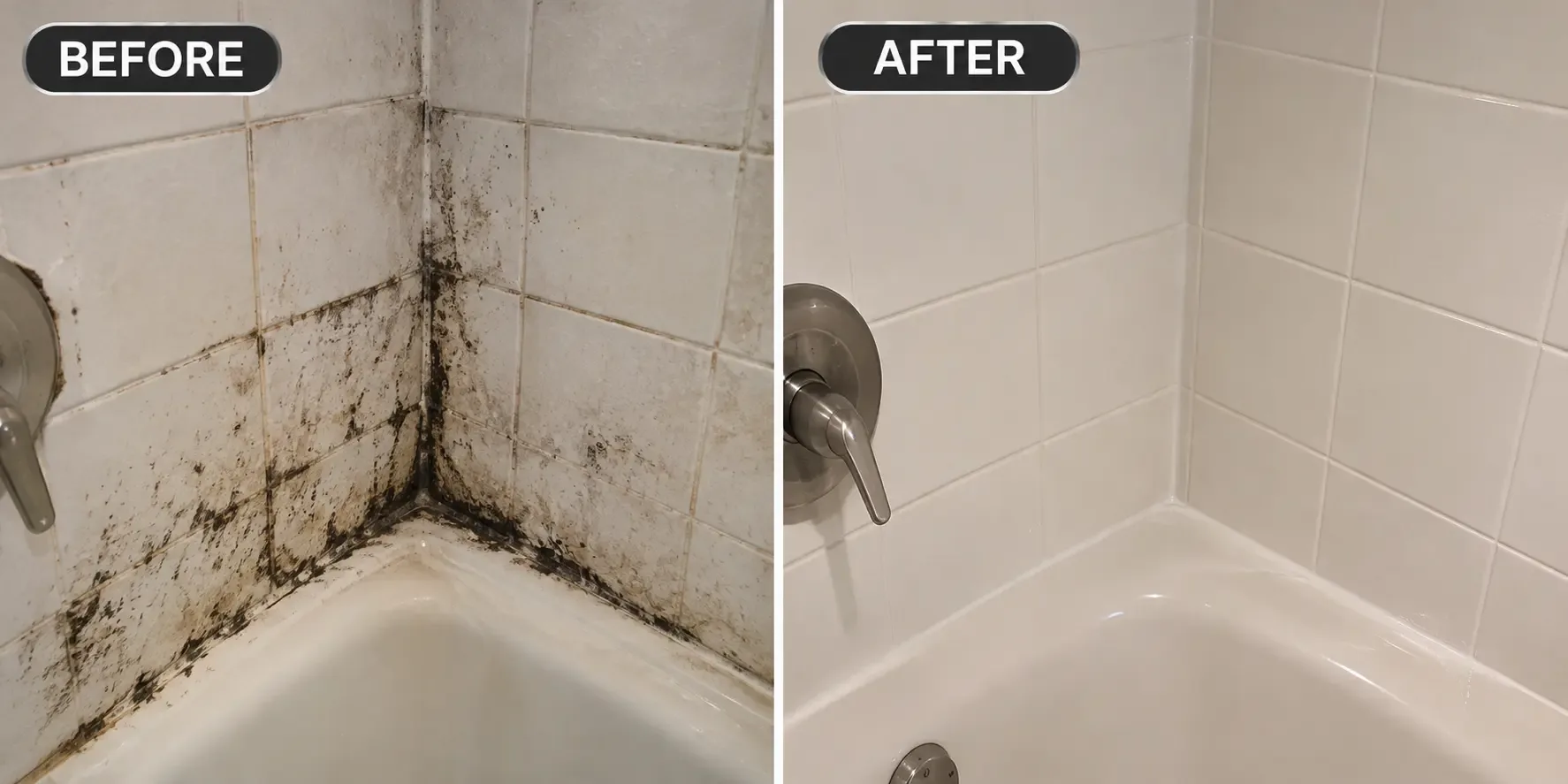
- Bathroom ceilings and closets: Steam that isn't vented out settles in the coolest spots, often the ceiling corners and inside closets on exterior walls.
- Bath fans venting into the attic: A fan that blows into the attic instead of outside moves the moisture into the insulation.
- Older plumbing in established neighborhoods: In older homes, supply lines, drains and water heaters are common leak sources.
- Landscape irrigation: Drip and spray irrigation against the foundation can wet the base of exterior walls.
How we handle mold in Menifee
1. Inspect and test
We look at the affected area, take moisture readings to see how far the water went, and test when it helps answer a question. If you already have a report from an independent inspector, we work from it.
2. Find and fix the water
Mold comes back if the moisture does. We find the leak, condensation or drainage problem and fix it as part of the job.
3. Contain and remove
We seal off the work area, remove moldy drywall, insulation and other porous materials, and clean the remaining surfaces with HEPA vacuums and an antimicrobial treatment.
4. Dry, check and rebuild
We confirm the area is dry before closing it up, then rebuild: drywall, insulation, paint, baseboards, cabinets or flooring, so the room is finished when we leave.
Menifee mold removal FAQ
My home is only a few years old. How can it have mold?
New homes can get mold from a construction defect, a leak, or simply indoor moisture with nowhere to go. A shower used daily without a working fan is enough. We find the cause, which matters if it's something the builder should fix.
Do you work in 55+ communities like Sun City?
Yes. We can work around community rules and keep the work area sealed and tidy, and we explain everything clearly before we start.
How long should I run my bathroom fan?
Run it during the shower and for about 20 minutes after. If the mirror and walls stay wet long after, the fan may be too small, blocked or venting into the attic.
What affects the cost of mold removal?
The cost depends on your home: how large the affected area is, which materials are involved (drywall, insulation, cabinets, flooring), how hard it is to reach, whether testing is needed, what it takes to fix the water source, and how much rebuilding is needed afterward. Because no two homes are the same, we don't publish one-size-fits-all prices. We'll visit your home, inspect, and give you personalized pricing with a free on-site estimate. Call or text (951) 292-0703.
Can I just clean mold with bleach?
On a small spot on a hard surface, like tile, cleaning is often fine. On porous materials like drywall, wood and insulation, bleach doesn't reach the mold growing inside the material, and the moisture problem is still there. The EPA's guidance is to fix the water problem, clean hard surfaces, and remove porous materials that are moldy. For areas larger than about 10 square feet, a professional is recommended.